

Why read this article
- Understand how inflation can affect new property investment in Australia.
- Learn why construction and property replacement costs matter to housing values.
- Explore the potential benefits and risks of investing in new property.
- See why property selection, location and holding capacity remain essential.
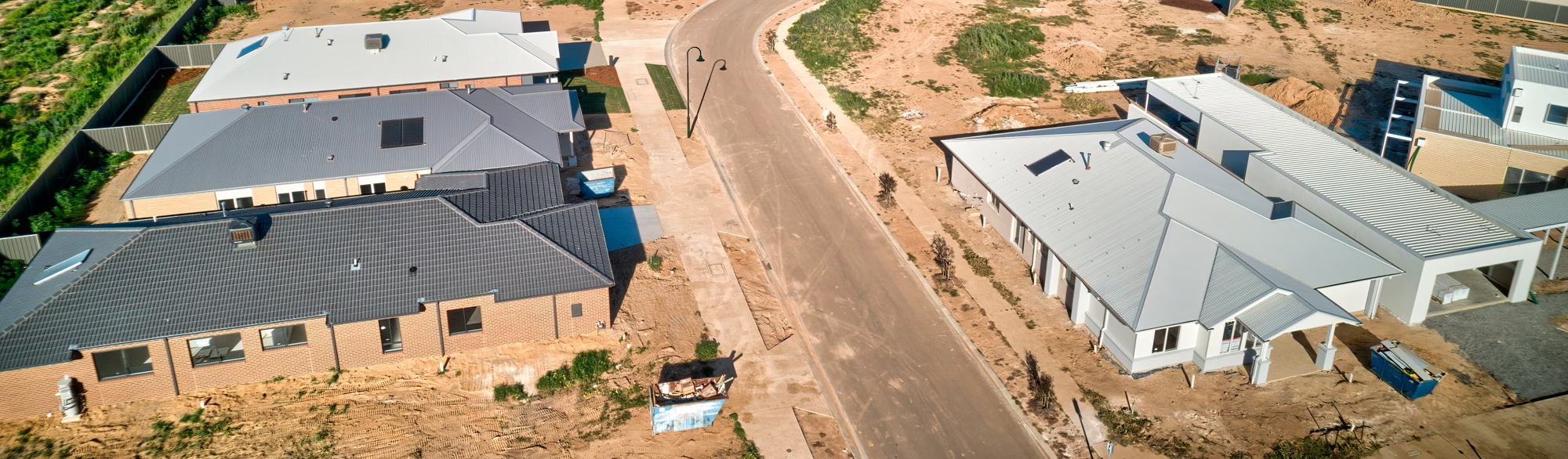
New housing investment remains a viable option for many Australians, particularly while inflation continues to place pressure on labour, building materials and the cost of delivering additional housing.
Inflation is usually discussed as a problem. It reduces the purchasing power of household income, increases everyday expenses and can make it more expensive to build, maintain and finance property.
However, inflation can affect an owner of a well-selected property differently. When the cost of constructing an equivalent home increases, existing and recently completed housing may become more expensive to reproduce. Rental income may also move over time as housing costs and market rents change.
This does not mean inflation automatically increases the market value of every property. Location, supply, buyer demand, property type, price, finance and local economic conditions remain important. However, rising construction and replacement costs help explain why new housing remains relevant within the Australian property investment market.
What inflation means for property investors
Inflation measures how quickly the prices of goods and services are increasing. In the 12 months to May 2026, the Australian Consumer Price Index rose 4.0%. The Housing category rose 6.5%, while new dwelling prices increased by 5.6% and rents increased by 3.6%.
For households, these increases can mean higher electricity bills, rent, insurance, maintenance and general living expenses. Cash that does not earn a return matching inflation also gradually loses purchasing power.
Property is sometimes described as a potential inflation hedge because it is a physical asset connected to land, housing demand, construction costs and rental markets. That description should not be interpreted as a guarantee. Property values can rise, remain flat or fall, and different markets can perform very differently.
A more balanced way to consider the relationship is that property may respond differently to inflation than cash. While cash remains a fixed dollar amount, the cost of land, labour, materials, infrastructure and replacement housing can change over time.
Why rising construction costs matter
The cost of building a home is influenced by more than timber, bricks and concrete. It can include:
- skilled trades and labour;
- building materials and transport;
- energy and fuel;
- design, engineering and professional services;
- planning and approval costs;
- site preparation and civil works;
- finance and holding costs;
- developer and builder margins; and
- the cost of delivering surrounding infrastructure.
ABS data showed that Australian building construction prices rose 4.2% over the 12 months to the March quarter of 2026. House construction prices rose 4.1%, while other residential building construction prices rose 4.2%. The ABS attributed continuing pressure to housing demand, constrained supply, labour costs and shortages affecting trades and materials.
The Reserve Bank of Australia has also reported continuing pressure on new dwelling inflation, including increases in concrete, steel, bricks, fuel and oil-based construction products.
These costs are important because a new property entering the market must generally be financially viable for the builder or developer. As the cost of delivering new housing increases, the price required to make future projects viable may also increase.
What is property replacement cost?
Property replacement cost is the estimated amount required to reproduce an equivalent property at current prices.
It is different from market value. Market value is determined by what buyers are prepared to pay in a particular market, while replacement cost considers what it may cost to acquire land and construct a comparable property today.
Replacement cost can include land, construction, professional fees, financing, leasing or marketing expenses and an allowance for development risk and profit.
The two values do not always move together. A property can trade below its replacement cost in a weak market, and a highly desirable property can sell well above its replacement cost because of its location, scarcity or buyer demand.
However, replacement cost remains an important property investment consideration. When comparable housing becomes substantially more expensive to reproduce, existing and newly completed properties may become relatively scarce or more difficult to replace at the same price.
A practical construction-cost example
Consider an illustrative home that would cost $600,000 to reproduce, excluding land.
If the cost of house construction increased by 4.1%, matching the national annual movement reported by the ABS for the March quarter of 2026, the indicative construction cost would increase by approximately:
$600,000 × 4.1% = $24,600
The equivalent property could therefore cost approximately $624,600 to construct one year later, before changes to land prices, professional fees, finance, infrastructure or developer margins.
This example does not mean the original property has automatically increased in value by $24,600. A bank valuation or sale price would still depend on comparable sales, location, demand, rental conditions and the property itself.
It demonstrates a different point: when construction costs increase, it becomes harder to deliver an equivalent new home at the previous price. Over time, that replacement-cost pressure may support the relative value of well-located housing that has already been completed or secured at an earlier cost base.
How inflation may work in a property investor’s favour
Inflation is not inherently beneficial. It can increase interest rates, reduce borrowing power and make properties more expensive to hold. However, several characteristics may allow a property investor to participate in parts of the inflation cycle.
The property may become more expensive to reproduce
Higher labour and material costs can increase the price required to deliver future housing. A property acquired before another period of construction-cost escalation may become comparatively more difficult to replace at its original purchase price.
Rental income may change over time
Rental income is determined by local supply, tenant demand, vacancy levels, property quality and rental regulations. It does not rise automatically with inflation.
However, ABS data showed rents rising by 3.6% over the year to May 2026, reflecting sustained low vacancy rates across many capital-city markets.
Where rental demand remains strong, rental income may increase over a long holding period. This can potentially improve the relationship between income and property expenses, although higher rent should never be assumed when assessing whether a property is affordable to hold.
Debt is fixed in nominal dollars
A property loan does not automatically increase because the general price level rises. Over a sufficiently long period, wages and rents may change while the original loan principal remains expressed in nominal dollars.
This can reduce the real, inflation-adjusted value of debt over time. However, the benefit can be offset by higher interest rates, refinancing risk or weak income growth. Borrowing to invest is a higher-risk strategy and only makes financial sense where the expected outcome, after tax, exceeds the full cost and risk of the investment and loan.
Property provides exposure to a real asset
Residential property is connected to physical land, materials, construction capacity and the ongoing need for housing. This does not make property risk-free, but it means its economic drivers differ from those of cash savings.
Accrue’s previous educational material has similarly explained that inflation may affect property through construction inputs, housing supply, rent and the cost of reproducing an equivalent home.
Why new property investment remains relevant
A new build investment property may offer several practical characteristics for investors to consider.
Exposure to current housing demand
New housing adds supply to areas where more homes are needed. The investment case is generally stronger where new property is supported by population growth, employment, infrastructure, limited competing supply and genuine owner-occupier or tenant demand.
Australia completed 43,816 dwellings in the March quarter of 2026, while dwelling commencements fell 11.2% during the quarter. The figures illustrate the continuing difficulty of delivering housing consistently and at scale.
Lower initial maintenance considerations
A newly completed property may require less immediate repair or renovation than an older property. Modern appliances, electrical systems, plumbing and structural components may also reduce some early maintenance uncertainty.
This does not eliminate maintenance expenses. Defects, owners corporation costs, landscaping, tenant damage and ordinary wear can still occur. Building contracts, warranties and defect processes should be reviewed carefully.
Modern tenant appeal
Energy efficiency, contemporary layouts, storage, transport access and nearby services may help a new property appeal to tenants and future owner-occupiers.
The strength of this appeal depends on the market. A new property in an oversupplied location may perform less effectively than a well-selected property in an area with diverse demand and limited competing supply.
Potential taxation considerations
New residential investment property may provide access to capital works deductions and depreciation for eligible assets, depending on the property, ownership structure and prevailing tax rules.
Tax outcomes vary and can affect future capital gains tax calculations. Investors should obtain advice from a qualified accountant or registered tax agent rather than relying on a general estimate of potential deductions.
Inflation does not make every new property a good investment
Rising construction costs should not be used to justify paying any price for a new property.
A property can be new and still be unsuitable because of:
- an inflated purchase price;
- excessive developer margin;
- weak local employment;
- limited tenant demand;
- a large future development pipeline;
- poor design or construction quality;
- high owners corporation fees;
- an unsuitable land-to-building mix;
- low owner-occupier appeal; or
- holding costs that place too much pressure on the investor.
It is also possible for construction costs to increase while property values in a particular market fall. Interest rates, credit availability, buyer confidence and local supply can outweigh replacement-cost pressure over shorter periods.
The investment decision therefore needs to consider both the asset and the investor’s capacity to hold it.
Holding capacity remains critical
Inflation can increase rent and replacement costs, but it can also increase insurance, rates, maintenance, living expenses and borrowing costs.
Investors should assess whether they could continue holding a property through:
- a vacancy;
- an unexpected repair;
- a period of weaker rental growth;
- changes in interest rates;
- higher property expenses; and
- changes to personal income or family circumstances.
APRA currently requires lenders to assess residential mortgage serviceability using a buffer of at least three percentage points above the loan interest rate. This is intended to improve borrower resilience if rates or household expenses rise.
Borrowing capacity should therefore not be treated as the same thing as borrowing comfort. The objective is not simply to acquire the largest possible property. It is to identify a suitable asset that can be held through changing economic and market conditions.
What to look for in a new property investment
A strong new property investment assessment may consider:
Local housing demand
Review population movement, household formation, employment, infrastructure, schools, transport and the needs of likely tenants and future buyers.
Supply pipeline
Assess how much competing housing is proposed, approved or under construction. Limited current supply does not necessarily mean limited future supply.
Purchase price and comparable evidence
Compare the property with established homes, recently completed developments, land values and alternative new projects. Newness alone does not justify a substantial price premium.
Rental evidence
Use comparable leased properties rather than relying only on a projected rental estimate supplied as part of the sale process.
Builder and developer capability
Consider experience, project history, contract terms, financial capacity and the process for managing construction delays or defects.
Cash flow and finance
Include interest, rates, insurance, management, vacancy, maintenance, owners corporation fees, land tax where applicable and a reasonable contingency.
Is new property still a viable investment?
New property investment remains a viable option for people who understand the risks, can sustain the holding costs and select property using research rather than relying on inflation alone.
Current inflation and construction data reinforce the central argument. Housing is expensive to deliver, construction inputs continue to rise and the supply of completed dwellings remains constrained. These conditions may make well-selected, appropriately priced new housing increasingly difficult to reproduce over time.
That does not guarantee capital growth or rental performance. Instead, it strengthens the case for assessing replacement cost, development feasibility and competing supply alongside the more familiar considerations of location, demand, rental income and borrowing capacity.
Final thoughts
Inflation is normally experienced as a rising cost. For an owner of a carefully selected property, it may also contribute to increases in rent, construction expenses and the amount required to reproduce comparable housing.
This is the critical distinction.
Inflation does not simply make a property more valuable. It can make housing more expensive to create. Where demand remains strong and supply is difficult or costly to deliver, that pressure may support the relative value of existing and newly completed housing stock over the longer term.
The opportunity is therefore not to assume that every property will benefit from inflation. It is to identify new property in markets where replacement-cost pressure is supported by genuine housing demand, limited competing supply, appropriate pricing and the investor’s ability to hold the asset through changing conditions.
How Accrue Real Estate Helps
At Accrue Real Estate, we help clients understand the factors behind a new property opportunity rather than relying on broad market claims.
Our work includes researching Australian property markets, assessing local housing demand and supply, comparing new property opportunities and reviewing the numbers connected to purchase price, rental income and estimated holding costs. We also help clients consider builder experience, development quality, location fundamentals and the amount of competing housing planned for the surrounding market.
Accrue specialises in sourcing new property opportunities and supports clients through the property research, shortlisting, due-diligence and purchase process. We work alongside a client’s lending, financial, legal, accounting or SMSF advisers where specialist advice is required.
Any information provided by Accrue Real Estate is general in nature and is intended to help readers understand property-related considerations only.
Article first prepared, July 2026
Disclaimer:
This content has been prepared on behalf of Accrue Real Estate Pty Ltd ABN 46 641 781 624.
Any information provided is general in nature only. It does not take into account the objectives, financial situation, borrowing capacity, needs or circumstances of any individual and does not constitute financial, investment, credit, taxation or legal advice.
Nothing in this article is a recommendation or statement of suitability in relation to a particular property, location, investment strategy, loan or financial product. Property values, construction costs, replacement values, rental income, vacancy rates, lending policies, interest rates, taxation rules and market conditions can change.
Examples are illustrative only and should not be interpreted as forecasts or representations of likely investment performance. Rising inflation or construction costs do not guarantee an increase in property value, rent or investment return. Market value and replacement cost are different measures and may move independently.
Borrowing to invest involves risk and can magnify both gains and losses. Investors remain responsible for loan repayments and property expenses if rent falls, a property is vacant, interest rates rise or the property declines in value.
Before making a property, lending, taxation, legal or investment decision, readers should consider their circumstances and obtain advice from appropriately licensed or qualified professionals. Past performance is not a reliable indicator of future performance.
Sources referenced
- Australian Bureau of Statistics — Consumer Price Index, Australia, May 2026.
- Australian Bureau of Statistics — Producer Price Indexes, Australia, March 2026.
- Australian Bureau of Statistics — Building Activity, Australia, March 2026.
- Reserve Bank of Australia — Statement on Monetary Policy, May 2026.
- Australian Prudential Regulation Authority — System Risk Outlook and macroprudential policy settings, 2026.
- Australian Securities and Investments Commission, Moneysmart — Borrowing to invest.
- Australian Taxation Office — Rental Properties Guide.
Get in Touch
If you’ve been thinking about property but unsure where to begin, you’re not alone. Accrue has helped thousands of clients better understand their situation, gain clarity on their options, and connect with the right professionals where needed. Take the next step and contact us today to learn how we can help.